Pickleball vocabulary can seem confusing when you’re first learning the game. This guide explains the most common pickleball terms in simple language so beginners can step onto the court with confidence.
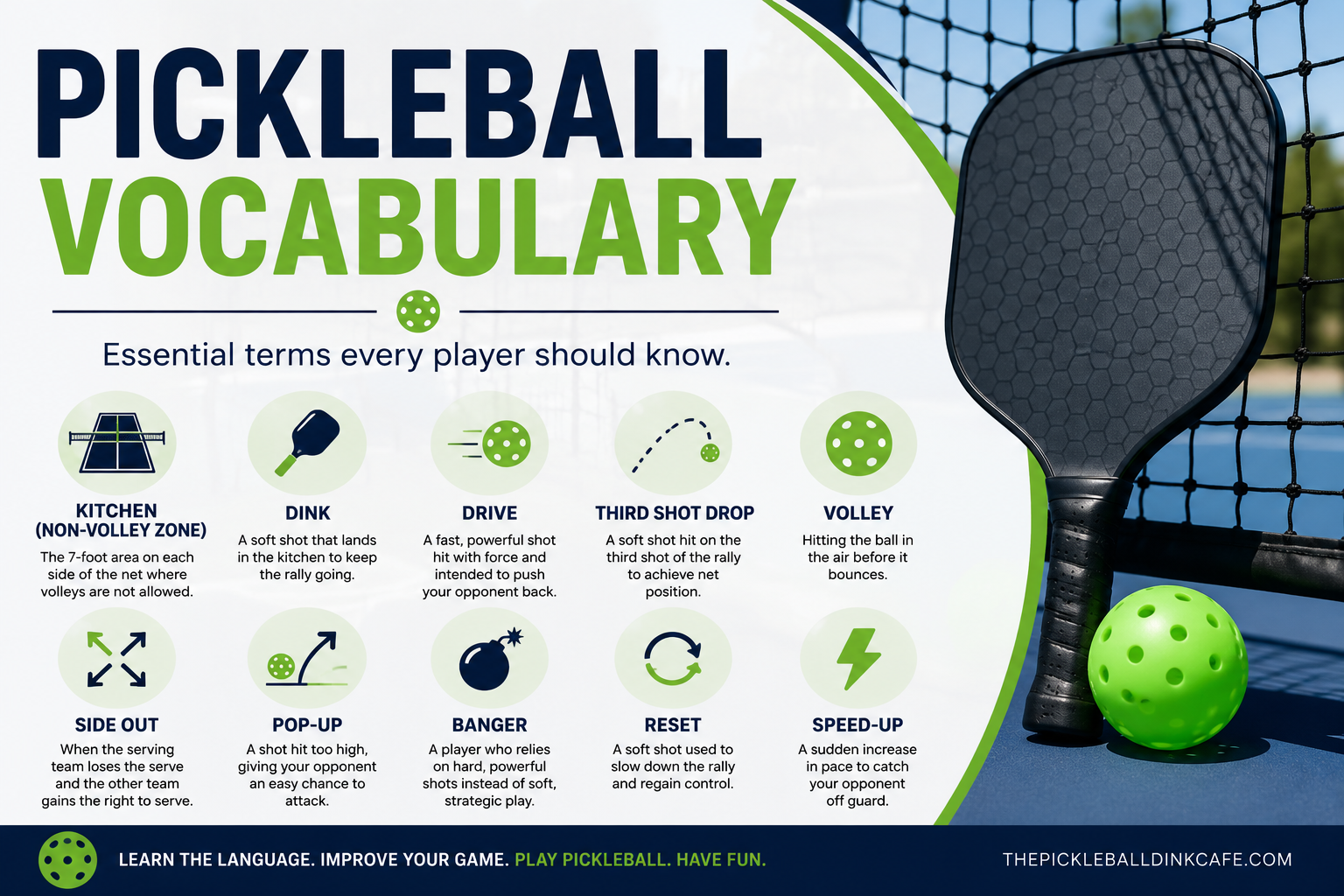
🥒 Kitchen (Non-Volley Zone)
The 7-foot non-volley zone on each side of the net where you cannot hit volleys.
🏓 Dink
A soft, controlled shot that lands in your opponent’s kitchen to keep the rally under control.
💥 Drive
A fast, low shot hit with power to pressure your opponent.
🎯 Third Shot Drop
A soft shot hit by the serving team on the third shot of the rally, allowing both partners to move safely to the kitchen line.
🎾 Volley
Hitting the ball out of the air before it bounces.
🔄 Side Out
When the serving team loses the serve and it passes to the opposing team.
🍿 Pop-Up
A shot hit too high, giving your opponent an easy opportunity to attack.
💣 Banger
A player who relies primarily on powerful drives instead of soft, strategic shots.
🧱 Reset
A soft defensive shot used to slow down a fast-paced rally and regain control.
⚡ Speed-Up
A sudden increase in pace during a dink rally, usually intended to surprise your opponent.
🤝 Shake and Bake
A doubles strategy where one partner hits a hard drive while the other moves forward looking to finish the point.
🔥 Erne
An advanced shot where a player moves outside the kitchen and volleys the ball near the net without stepping into the Non-Volley Zone.
🌎 ATP (Around the Post)
A legal shot that travels around the outside of the net post instead of over the net.
🚦 Stacking
A doubles positioning strategy used so partners can stay on their preferred sides of the court.
☁️ Lob
A high shot hit over your opponent’s head, forcing them to retreat.
❌ Fault
Any rule violation that immediately ends the rally or results in the loss of the serve.
🏁 Rally
The continuous exchange of shots after the serve until one team commits a fault.
🎯 Drop Shot
A soft shot designed to land in your opponent’s kitchen, forcing them to move forward.
↗️ Crosscourt Dink
A dink hit diagonally across the court. Crosscourt dinks travel over the lowest part of the net and provide a larger target area.
📍 Baseline
The back boundary line of the pickleball court.
📏 Sideline
The side boundary lines that define the width of the court.
➖ Centerline
The line that divides each side into left and right service courts.
👣 Split Step
A small hop taken just before your opponent hits the ball to improve balance and reaction time.
🧹 Paddle Face
The flat hitting surface of the paddle.
🎨 Sweet Spot
The center area of the paddle face that produces the most consistent and solid contact.
✋ Grip Size
The circumference of the paddle handle. Choosing the correct grip size improves comfort and control.
🎒 Transition Zone
The area between the baseline and the kitchen where players often move while advancing to the net.
🏃 Ready Position
An athletic stance with knees bent and paddle held chest-high, allowing you to react quickly.
🎯 Placement
Hitting the ball to specific locations on the court instead of relying on power.
🧠 Unforced Error
A mistake made without significant pressure from your opponent, such as hitting the ball into the net or out of bounds.
📢 “Mine!”
A common doubles communication call used to let your partner know you are taking the shot.
🏆 Traditional Scoring
The standard scoring system where only the serving team can earn points.
⚖️ Rally Scoring
An alternative scoring system where every rally results in a point, regardless of which team served. This format is used in some leagues and special events.
Learning this pickleball vocabulary will help you understand instruction, strategy, and conversations on the court much faster.
📚 Continue Learning Pickleball
inner Guide
🏓 How to Play Pickleball
Learn the rules, scoring, serving, and kitchen basics.
🟠 Read Beginner Guide
🏓 Best Beginner Pickleball Paddles
Find the best paddles for new players.
🟠 View Paddles
🥇 Best Pickleball Balls
Compare indoor and outdoor pickleballs.
🟠 See Balls
👟 Best Pickleball Shoes
Find shoes with great grip and support.
🟠 View Shoes