Introduction
Pickleball kitchen rules are the most misunderstood part of the sport, and nothing ends a friendly game of open play faster than someone yelling “kitchen!” while you stand there with absolutely no idea what you did wrong.
I’ve watched players who’ve been in the sport for two years argue about it courtside. I’ve also watched brand-new players get called for a fault they never actually committed, because the person calling it didn’t know the rule either.
So let’s fix that. This is every kitchen rule, in plain English, based on the current 2026 USA Pickleball Official Rulebook. By the end you’ll know exactly what you can and can’t do, and you’ll be the person on court who settles the argument instead of starting it.
New to the sport entirely? Start with our guide on how to play pickleball and come back here once you’ve got the basics down.
What is the kitchen in pickleball?
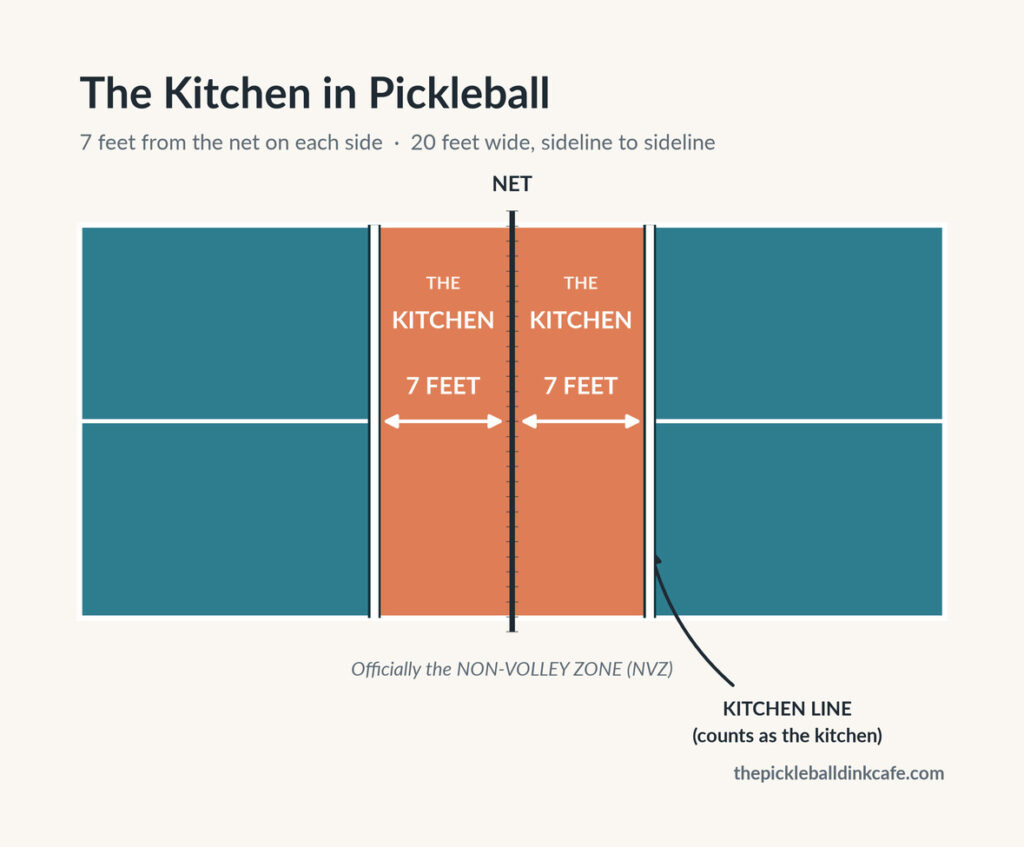
The kitchen is the 7-foot area on each side of the pickleball net, officially called the non-volley zone (NVZ). Players may stand in the kitchen and hit balls that have bounced, but they cannot volley — hit the ball out of the air — while touching the zone or its boundary line.
That’s the short version. Now the details that actually matter on court.
The kitchen is a rectangle of court running along both sides of the net. Here are the dimensions:
- 7 feet deep from the net on each side
- 20 feet wide, extending from sideline to sideline
- 14 feet total across both sides of the net combined
The line marking the back edge of the zone is called the non-volley line, or more commonly, the kitchen line.
One detail that catches everyone: the kitchen line is part of the kitchen. Touching the line is exactly the same as standing inside the zone. There’s no “on the line is fine” in pickleball the way there is in some other sports.
Nobody knows for certain where the word “kitchen” came from. It isn’t in the rulebook at all — the official term is only ever “non-volley zone.” Most people think it came over from shuffleboard, where the kitchen is a penalty area. If you want more of the sport’s odd vocabulary, we’ve got a full breakdown of essential pickleball terms.
Pickleball kitchen rules at a glance
If you only read one section, read this one:
- You may stand in the kitchen any time you want. There is no rule against it.
- You may not volley — hit the ball out of the air before it bounces — while touching the kitchen or the kitchen line.
- The kitchen line counts as the kitchen. Touching it is the same as standing inside.
- Your momentum counts too. If your follow-through carries you into the zone after a volley, it’s a fault.
- Once you’ve been in the kitchen, both feet must re-establish completely outside it before you can volley again.
- Bounced balls are always fair game from inside the kitchen. That’s what dinking is.
Everything below is a clarification of those six points.
The core pickleball kitchen rules, in one sentence
Ready? Here it is:
You cannot volley the ball while touching the kitchen or the kitchen line.
That’s it. That’s the whole thing. Everything else in this article is just a clarification of that one sentence.
A volley is “a strike of the ball before the ball bounces” (Section 2, Definitions). So the rule is really saying: don’t hit a ball out of the air while any part of you is in that 7-foot zone.
A note on rule numbers. The 2026 rulebook restructured the sport’s rules into 25 sections and moved the non-volley zone rules from Section 9 to Section 11, “Non-Volley Zone Infractions.” Most guides still cite the old 9.A–9.H numbering. Every citation on this page reflects the current 2026 numbering.
Here’s the part that unlocks everything: the kitchen restricts a type of shot, not a place you’re allowed to stand. You can walk into the kitchen, stand in it, eat lunch in it. The zone only becomes a problem the instant you try to volley from inside it.
What counts as “touching” the kitchen
This is where people get burned. The rule isn’t just about your feet.
Rule 11.A.1 puts it this way: “When a volleying player or anything that has contact with the volleying player (including the player’s partner) contacts the non-volley zone, it is a fault against the player.” That includes:
- Either foot. Obviously.
- Your paddle. If the paddle in your hand touches down in the kitchen during the act of volleying, that’s a fault.
- Your hand or knee. If you volley and then brace yourself on the court inside the zone, fault.
- Your hat or sunglasses — while you’re still wearing them.
- Your partner. If your partner is standing in the kitchen and you’re touching them while you volley, that’s a fault on your team.
One honest caveat: the rule says “anything that has contact with the volleying player.” An item that has already come free of you — a paddle you’ve let go of, a hat that blew off a moment earlier — is arguably no longer in contact with you when it lands. You’ll see this stated as a definite fault all over the internet. The 2026 rulebook doesn’t actually say that, so don’t argue it as settled.
Wheelchair players get a different standard. Under Rule 25.A.10, “the front (smaller) wheels and the rear stabilizing wheels may contact the non-volley zone at any time” — not merely during a volley.
The momentum rule: the one that feels unfair
This is the rule that causes the most courtside arguments, so read this section twice.
The act of volleying doesn’t end when your paddle hits the ball. Section 2 of the rulebook defines it precisely: “The act of volleying begins when the ball is hit out of the air before bouncing (i.e., volleyed) and ends when the player’s movement from the follow-through action (i.e., momentum) stops.”
So if you volley from behind the line but your own momentum carries you into the kitchen afterward, it’s a fault (Rule 11.A.2). Even though you made clean contact from a legal position.
And here’s the brutal part. The clock doesn’t save you. Rule 11.A.2 specifies that the fault stands “even after the ball becomes dead.” If you smash a ball, teeter on one foot at the line, and finally lose your balance and step in three seconds later, it’s still a fault. It’s a fault if:
- Your opponent already returned the ball
- The rally already ended
- A point was already scored
- The ball was called dead
The only thing that clears you is your momentum fully stopping. If you volley, come to a complete and balanced stop behind the line, and then casually step into the kitchen, you’re fine. The movement has to be finished.
A note on partners: if your momentum carries you into your partner while they’re standing in the kitchen, that’s also a fault. And no, your partner can’t catch you or hold you up to save you — if they’re touching the kitchen and you’re touching them, you’ve got the same problem.
If you’re constantly lunging and stumbling forward at the line, that’s worth addressing for reasons beyond the scorecard. Falls at the net are one of the most common ways rec players get hurt, which we cover in our guide to pickleball injury prevention.
Getting out of the kitchen: the reset rule
Say you stepped into the kitchen to chase down a drop shot. Now your opponent lobs one back at you. Can you volley it?
Not until you reset. Rule 11.A.3 covers it: “After contacting the non-volley zone, when a player volleys a ball before both feet contact the playing surface completely outside the non-volley zone, it is a fault against the player.”
“Both feet” and “completely outside” are doing a lot of work in that sentence. Dragging one toe back doesn’t count. Having a heel on the line doesn’t count. Both feet, fully behind the line, planted on the court.
Until that happens, your only legal option is to let the ball bounce before you hit it.
For wheelchair players, the equivalent is both large rear wheels re-establishing contact completely outside the zone (Rule 25.A.10.c).
What you’re absolutely allowed to do in the kitchen
Beginners over-correct on this constantly, treating the kitchen like hot lava and giving up easy points. Here’s what’s completely legal:
You can enter the kitchen any time you want. Before a shot, after a shot, in the middle of a rally, for no reason at all. Rule 11.A says a player “may contact the non-volley zone at any time except during the act of volleying a ball.” There is no rule against standing in the kitchen.
You can hit a ball that has bounced while standing in the kitchen. This is the whole point. Once the ball bounces, it’s not a volley anymore, so the restriction doesn’t apply. Dinks and drop shots that land in the kitchen are meant to be played from the kitchen.
You don’t have to leave after hitting a bounced ball. The 2026 rulebook lists no rule requiring you to scramble out — the only prohibition in Section 11 concerns volleying, and Rule 11.A permits contact with the zone at any other time. You can stay in there as long as you like. Just remember you’ll need to reset both feet before you can volley again.
Your partner can be standing in the kitchen while you hit. Rule 11.A.1 makes it a fault only when the volleying player is in contact with a partner who is touching the zone. Your partner simply standing there, untouched by you, is legal.
You can volley a ball that’s above the kitchen. The kitchen is a two-dimensional patch of ground, not a force field extending upward. If your feet are behind the line, you can lean, reach, and volley a ball hanging in the air over the kitchen all day long.
You can jump and volley over the kitchen — as long as you take off from behind the line and land behind the line. Take off legal, land legal, no contact with the zone. Perfectly fine, if athletically ambitious.
The serve has to clear the kitchen too
Here’s a kitchen rule that lives outside the non-volley zone section entirely, which is why a lot of guides miss it.
Under the 2026 serve rule, “the served ball must clear the opponent’s non-volley zone, with or without touching the net, and land in the correct service court” (Rule 7.E). The rulebook then spells out the consequence twice:
- Rule 7.E.2 — Fault, Serve Lands in Non-Volley Zone: “When a served ball lands in the non-volley zone, it is a fault against the server.”
- Rule 8.C — ‘Out’ Ball: a served ball that doesn’t land in the correct service court, “including one that lands on the non-volley zone line, is ‘out.’”
In practical terms: a serve that lands in the kitchen is a fault, and so is one that clips the kitchen line. Your serve has to clear that line entirely and land in the correct service box. Note how unusual this is — everywhere else on the court, a ball touching a line is in. The kitchen line on a serve is the exception.
Pickleball kitchen rules: 12 situations that confuse people
| Situation | Legal? | Why |
|---|---|---|
| Standing in the kitchen doing nothing | ✅ Legal | No rule against occupying the zone |
| Hitting a ball that bounced, while in the kitchen | ✅ Legal | Not a volley once it bounces |
| Volleying with one foot on the kitchen line | ❌ Fault | The line is part of the kitchen |
| Volleying from behind the line, then stepping in | ❌ Fault | Momentum rule, Rule 11.A.2 |
| Volleying, coming to a full stop, then stepping in | ✅ Legal | Momentum ended before contact |
| Jumping from behind the line, volleying, landing behind the line | ✅ Legal | Never contacted the zone |
| Jumping from behind the line, volleying, landing in the kitchen | ❌ Fault | Landing is part of the act |
| Leaning over the kitchen to volley, feet planted behind line | ✅ Legal | The zone is 2D, not 3D |
| Volleying while your hat is on your head and brushes the zone | ❌ Fault | Anything in contact with you counts, Rule 11.A.1 |
| Volleying while your partner stands in the kitchen | ✅ Legal | Rule 11.A.1 — legal as long as you aren’t touching them |
| Stepping into the kitchen, then volleying without resetting | ❌ Fault | Must re-establish both feet, Rule 11.A.3 |
| A serve that lands on the kitchen line | ❌ Fault | Rules 7.E.2 and 8.C |
Three myths about pickleball kitchen rules
Myth: “You can’t step in the kitchen.” The most common misconception in the sport. You can step in whenever you want. You just can’t volley while you’re in there.
Myth: “You have to get out of the kitchen right after you hit.” No such rule exists. Section 11 restricts volleying and nothing else, and Rule 11.A permits contact with the zone at any other time.
Myth: “The kitchen is a no-go zone above the ground too.” It’s a surface, not a column of air. Feet behind the line means you can volley a ball over the kitchen legally.
Why the rule exists at all
Worth understanding, because it makes the rule easier to remember.
Without the kitchen, pickleball would be broken. The court is small and the net is low. Two athletic players could simply camp at the net and slam every single ball downward at feet from three feet away. There would be no rallies, no strategy, and no reason for anyone shorter or slower to play.
The kitchen forces everyone back 7 feet. That’s what creates the dink game, the soft third-shot drop, and the patient exchanges that make pickleball fun for a 25-year-old and a 70-year-old on the same court. It’s arguably the single rule that made the sport spread the way it did.
How to stop breaking the pickleball kitchen rules
Knowing the rule and not breaking it are different problems. Four things that help:
Set your feet before the ball arrives. Most momentum faults come from arriving late and lunging. Get to the line early and stop moving.
Use the line as a physical reference. Plant your toes an inch or two behind it rather than right on it. That inch is your margin for error.
Let it bounce when you’re in doubt. If you’ve drifted into the kitchen and a ball is coming, don’t gamble on a volley. Let it bounce and hit a dink. You lose a little offense and avoid a certain fault.
Check your shoes. This sounds like a plug, but it genuinely matters. Running shoes have soft, rolling heels built for forward motion, and they’ll slide you across the kitchen line on a hard stop. Court shoes have flat, grippy outsoles designed for exactly the lateral stop-and-plant the kitchen line demands. If you’re stumbling forward on every volley, your footwear may be the actual culprit — here are the best pickleball shoes for stopping on a dime.
Frequently asked questions
What are the pickleball kitchen rules?
The pickleball kitchen rules state that you may not volley the ball while touching the non-volley zone or the non-volley line. You may stand in the zone at any time, and you may hit any ball that has bounced from inside it. Your follow-through momentum must also stay out of the zone.
Can you step in the kitchen in pickleball?
Yes. You can enter the non-volley zone at any time. The only restriction is that you cannot volley — hit the ball out of the air before it bounces — while touching the kitchen or the kitchen line.
Is the kitchen line part of the kitchen?
Yes. Touching the non-volley line counts as being in the non-volley zone. There’s no benefit of the doubt for the line.
How big is the pickleball kitchen?
Seven feet from the net on each side and 20 feet wide, sideline to sideline. That’s 14 feet total across both sides of the net.
Can you hit the ball in the kitchen if it bounces?
Yes, and you should. Once the ball has bounced, the shot is no longer a volley, so the kitchen restriction doesn’t apply. This is exactly how dinks are played.
Can your momentum carry you into the kitchen after a volley?
No, that’s a fault under Rule 11.A.2, which specifies it applies “even after the ball becomes dead.” If your follow-through momentum eventually puts you in the kitchen, it’s a fault even if the rally already ended. You’re only clear once your momentum has fully stopped.
Do you have to leave the kitchen after hitting a bounced ball?
No. Rule 11.A permits contact with the non-volley zone at any time except during the act of volleying, so you can stay as long as you want. But you’ll need to get both feet completely outside the zone before you can legally volley again.
Can a serve land in the kitchen?
No. Under Rule 7.E the served ball must clear the opponent’s non-volley zone entirely and land in the correct service court. Rule 7.E.2 makes a serve landing in the zone a fault against the server, and Rule 8.C makes a serve landing on the non-volley zone line “out.”
Can I volley if my partner is in the kitchen?
Yes, as long as you aren’t in physical contact with them. Rule 11.A.1 makes it a fault only when the volleying player, or something touching them, contacts the zone — and that includes a partner you’re touching.
Wrapping up
All of the pickleball kitchen rules reduce to one sentence, and if you remember it you’ll never get this wrong again: you can stand anywhere you want, but you can’t hit a ball out of the air while touching the kitchen — and your momentum has to stay out too.
That’s it. Every other clause in the rulebook is a footnote on that sentence.
Once the kitchen clicks, the soft game opens up and pickleball stops being a slugfest. If you’re still assembling your setup, our beginner gear checklist covers the five things you actually need, and our best beginner paddles guide will help you find something forgiving enough to learn the dink game with.
And if you want to announce your kitchen expertise to the world, we’ve got pickleball shirts for that.
Sources
USA Pickleball Rules landing page — https://usapickleball.org/rules/
2026 USA Pickleball Rulebook Change Document — https://usapickleball.org/docs/rules/USAP-Rulebook-Change-Document.pdf
The Pickleball Kitchen (NVZ or Non-Volley Zone), PlayPickleball — https://www.playpickleball.com/official-pickleball-rules-kitchen-non-volley-zone-nvz/
What Is The Pickleball Kitchen Rule, Pickleball Kitchen — https://pickleballkitchen.com/pickleball-rules-what-is-the-kitchen-rule/
Pickleball Kitchen Rules: Separating Fact from Fiction, Paddletek — https://www.paddletek.com/blogs/news/pickleball-kitchen-rule